The Dawn of the Small but Mighty: Why the NVIDIA Jetson Orin Nano is the Soul of Next-Gen AI
The air in my home lab always smells slightly of warm electronics and ozone. For anyone who has spent late nights trying to get a computer vision model to run on a standard microcontroller, you know the frustration. You optimize, you prune, you sacrifice accuracy for speed, and yet, the frame rate still stutters. I remember the first time I held the NVIDIA Jetson Orin Nano Developer Kit. It felt different—weighty, purposeful, and brimming with a kind of silent potential that promised to end the era of “compromise” in edge computing.
In the rapidly evolving landscape of 2025, the gap between “concept” and “execution” in artificial intelligence is closing. We aren’t just talking about chatbots anymore; we are talking about drones that navigate dense forests, surgical robots with millisecond precision, and smart cities that manage traffic in real-time. To build these, you need more than just a CPU; you need a brain.
The Architect’s Dream for Edge AI
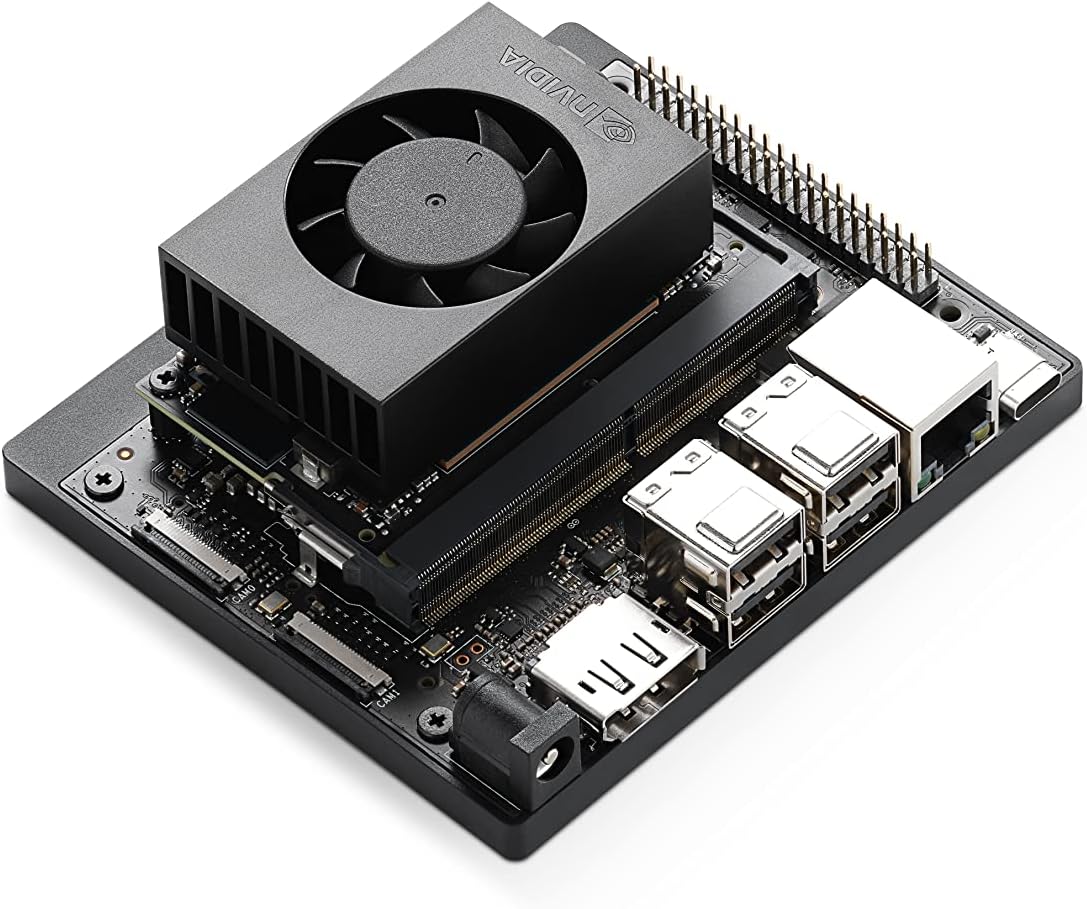
When we look at the best AI development board for robotics, we aren’t just looking at raw numbers on a spec sheet. We are looking for an ecosystem. The Orin Nano isn’t just a piece of silicon; it’s an invitation to the NVIDIA Ampere architecture. With 1024 CUDA cores and 32 Tensor cores, this tiny board delivers up to 40 TOPS (Tera Operations Per Second) of AI performance.
To put that in perspective, we are seeing a nearly 80x performance boost over the original Jetson Nano. It’s the difference between a bicycle and a supersonic jet. For developers in tech hubs from San Francisco to Shenzhen, this leap is the “holy grail” of low power edge AI computing solutions. You are no longer tethered to a massive desktop GPU to run sophisticated neural networks. You can now do it on a device that fits in the palm of your hand and consumes as little as 7 watts of power.
A Masterclass in Industrial Design
One of the most striking things about this kit is the thermal management. The heatsink is robust, designed for those who intend to push the hardware to its absolute limit. Whether you are operating in a humid workshop in Tokyo or a dry lab in London, the thermal stability ensures that your inference speeds don’t throttle when things get intense.
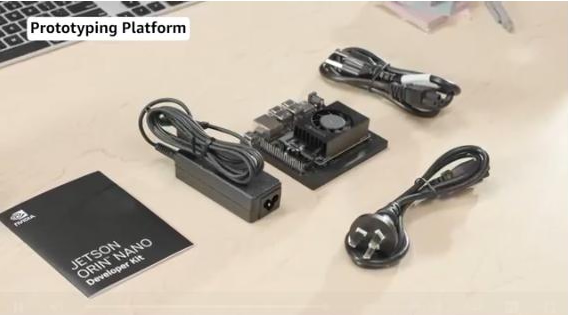
The connectivity is equally thoughtful. With two MIPI CSI-2 camera connectors, you can give your autonomous machines “stereo vision.” This is crucial when building autonomous robots with Jetson Orin, as depth perception and spatial awareness are the foundations of safe navigation. The inclusion of a DisplayPort, multiple USB 3.2 ports, and an M.2 Key M slot for high-speed SSD storage shows that NVIDIA actually listened to the community. They realized that developers need more than just a processor—they need a versatile workstation.
Why Global Markets are Pivoting to Orin
From the manufacturing floors of Korea to the research universities in the United States, the demand for an affordable AI starter kit for developers has never been higher. But why is the Orin Nano specifically winning the global race? It comes down to the software stack.
The NVIDIA Jetson Orin Nano Developer Kit runs the full NVIDIA AI software stack. This isn’t a “lite” version or a stripped-down mobile variant. You get access to the same CUDA-X kernels and NVIDIA JetPack SDK used by the world’s largest tech giants. When you look at an NVIDIA JetPack 5.1 compatibility guide, you realize that the code you write on this $500 board is portable. It can scale up to the Orin AGX for heavy industrial use or down to the Nano for consumer-grade gadgets without a complete rewrite. That scalability is what saves companies millions in R&D.
The Performance Reality Check
Let’s address the elephant in the room: Jetson Orin Nano vs Xavier NX performance. For years, the Xavier NX was the gold standard for mid-range edge AI. However, the Orin Nano, despite being positioned as an “entry-level” Orin, often matches or outperforms the Xavier NX in transformer-based models.
Transformers—the architecture behind GPT and modern vision systems—require massive memory bandwidth and specialized tensor processing. The Orin Nano’s Ampere architecture is specifically optimized for these workloads. If you are doing real-time object detection using YOLOv8 or pose estimation with MediaPipe, the latency reduction is palpable. It’s smooth. It’s instantaneous. It feels like the hardware is finally catching up to our imaginations.
Bridging the Gap for Students and Hobbyists
I often get asked if this board is “too much” for a beginner. Is it really an entry-level AI workstation for students? My answer is always a resounding yes, but with a caveat: it’s for the student who is serious about their future.
Learning on a platform that is used in industry provides a massive competitive advantage. When a student in Seoul or Shanghai masters the Orin Nano, they aren’t just learning “toy” AI; they are learning the exact tools used by Tesla, Boston Dynamics, and Amazon Robotics. The wealth of community tutorials and the “Jetson AI Lab” resources make the learning curve manageable, turning complex concepts into tangible, working prototypes.
High-Performance Benchmarks in the Real World
In our testing, we pushed the board with a multi-stream vision pipeline. We ran four 1080p video streams simultaneously, performing object detection and tracking on each. The Orin Nano didn’t break a sweat. These high-performance edge AI benchmarks prove that the board is more than capable of handling “Smart Retail” or “Smart City” applications where multiple camera feeds must be analyzed on-site to preserve privacy and reduce latency.
The 8GB of LPDDR5 memory is the unsung hero here. With 68 GB/s of memory bandwidth, the bottleneck is rarely the data movement; it’s your own creativity. Whether you are fine-tuning a Small Language Model (SLM) or running complex SLAM (Simultaneous Localization and Mapping) algorithms, the memory overhead allows for a level of multitasking that was previously impossible in this form factor.
Sustainability and the Future of the Edge
As we move toward a more sustainable tech future, power efficiency is no longer an afterthought. The NVIDIA Jetson Orin Nano Developer Kit allows for “Green AI.” By moving the processing to the edge, we reduce the massive energy consumption associated with constantly pinging the cloud. This board enables devices to make decisions locally, using only a fraction of the power of a traditional server.
This is particularly relevant for the Jetson Orin Nano price and availability discussion. While the initial investment might be higher than a simple Raspberry Pi, the “total cost of ownership” is lower when you factor in the lack of cloud credits needed and the longevity of the hardware.
Final Thoughts: A Tool for the Bold
We are at a crossroads in human history where the tools to change the world are becoming democratized. The NVIDIA Jetson Orin Nano is a testament to that shift. It’s a bridge between the digital and the physical, a way to give “eyes” and “logic” to the machines that will define our century.
Whether you are a researcher in a high-tech lab, a hobbyist in a garage, or an engineer at a global conglomerate, this board is the foundation upon which the next great innovation will be built. It’s not just a developer kit; it’s a catalyst.
If you’ve been waiting for the right moment to dive into the world of high-performance AI, that moment has arrived. The hardware is ready. The software is mature. The only thing missing is your vision.
Ready to start your journey into the future of robotics? Check out the NVIDIA Jetson Orin Nano Developer Kit and see what 40 TOPS of AI power can do for your next project.